

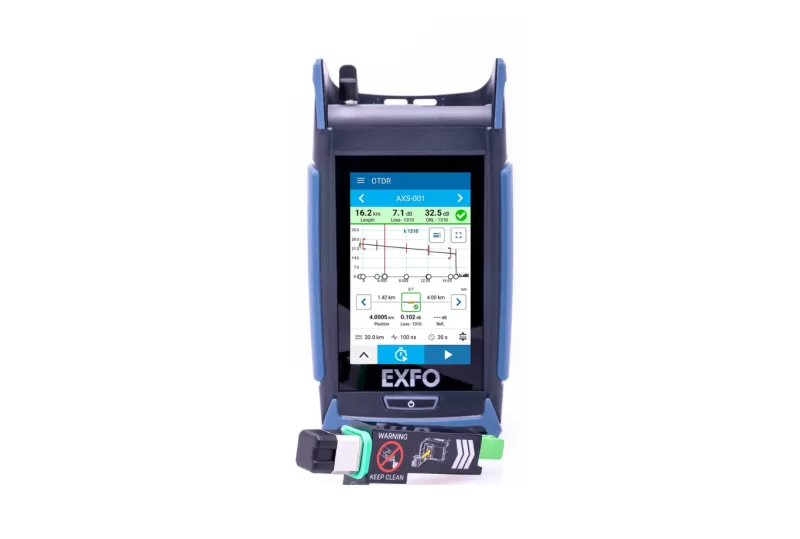
Optimized for FTTx fiber deployments and troubleshooting, and well-suited for metro network environments.
An OTDR (Optical Time-Domain Reflectometer) is a fiber testing instrument used to measure and analyze the performance of optical fiber links. It sends an optical pulse into a fiber and analyzes the returned backscatter and reflections to identify events along the fiber link.
OTDR testing helps locate fiber faults, measure fiber length, evaluate attenuation, identify splice and connector losses, and analyze reflective events. It is widely used for fiber installation, commissioning, troubleshooting, maintenance, and network performance verification.
Khushi Communications offers a range of OTDR solutions designed for telecom, FTTH/FTTx, data center, enterprise, and other optical fiber networks.
Explore our range of OTDR solutions for different fiber testing and troubleshooting requirements. Depending on the application, OTDR solutions can support different wavelengths, dynamic ranges, testing distances, and network configurations.
Our range includes OTDR solutions from leading manufacturers for applications such as fiber characterization, fault location, network commissioning, and optical fiber maintenance.
Explore our OTDR products to find a solution suitable for your fiber testing requirements.
An OTDR is an optical fiber test instrument that provides a graphical representation, or trace, of events occurring along an optical fiber.
By analyzing the OTDR trace, technicians can identify and measure:
Fiber length
Fiber attenuation
Splice loss
Connector loss
Reflective events
Fiber breaks and faults
Bends and other loss events
Distance to a fault
This makes OTDR an important tool for verifying fiber links and troubleshooting problems in optical communication networks.
An OTDR works by sending a short optical pulse into the fiber under test. A small portion of the optical signal is naturally scattered back toward the instrument due to Rayleigh scattering, while reflections can occur at connectors, splices, breaks, and other events.
The OTDR measures the returned optical signal and calculates the distance and loss associated with events along the fiber. The results are displayed as an OTDR trace, allowing technicians to evaluate the condition of the fiber link and identify the location of potential faults.
OTDR solutions are used across a wide range of fiber optic testing applications, including:
Fiber optic installation and commissioning
FTTH and FTTx network testing
Telecom network maintenance
Fiber link troubleshooting
Data center fiber testing
Long-haul fiber networks
Metro and access networks
PON and optical network testing
Fiber fault detection and location
Preventive fiber maintenance
OTDR testing can help technicians verify newly installed links and quickly troubleshoot existing networks when unexpected attenuation or connectivity issues occur.
When selecting an OTDR, it is important to consider the requirements of the fiber network and the type of testing being performed. Important parameters include:
Dynamic Range: Determines the maximum optical loss that the OTDR can measure and influences the testing distance.
Wavelength: Different wavelengths may be used depending on the fiber application and network architecture.
Event Dead Zone: Indicates the minimum distance required between closely spaced events for the OTDR to distinguish them.
Attenuation Dead Zone: Important when measuring loss between events located close together.
Testing Distance: The required measurement range depends on the length and type of fiber link.
Fiber Type: The OTDR should be suitable for the single-mode or multimode fiber being tested.
PON Testing: For access networks, specialized OTDR capabilities may be required to test through splitters and other passive optical components.
The right OTDR depends on the network, fiber type, testing distance, and application. Before selecting an OTDR, consider the required wavelengths, dynamic range, measurement distance, dead zones, connector configuration, and available testing functions.
For FTTH and access networks, PON testing capabilities can be particularly important. For telecom and long-distance networks, a higher dynamic range and appropriate testing distance may be required.
A portable OTDR can also be useful for field technicians who need to perform testing, troubleshooting, and maintenance at different network locations.
Khushi Communications provides fiber optic testing and measurement solutions for telecom, networking, data center, and optical communication applications.
Our OTDR portfolio helps network professionals perform fiber characterization, fault detection, commissioning, troubleshooting, and maintenance.
Contact our team to discuss your fiber testing requirements and identify an OTDR solution suitable for your application.
An OTDR, or Optical Time-Domain Reflectometer, is a fiber testing instrument used to analyze optical fiber links and identify events such as loss, reflections, splices, connectors, and fiber faults.
An OTDR is used for fiber characterization, fault detection, fault location, fiber length measurement, attenuation measurement, splice-loss analysis, and optical network maintenance.
An OTDR sends an optical pulse through the fiber and analyzes returned backscatter and reflections. The resulting trace can show the location and characteristics of faults or other events along the fiber.
Yes. OTDR solutions can be used for FTTH and FTTx testing. Depending on the network architecture, an OTDR with suitable PON testing capabilities may be required.
Important parameters include dynamic range, wavelength, testing distance, event dead zone, attenuation dead zone, fiber type, connector configuration, and application-specific testing capabilities.
An OTDR provides information about events and loss along the length of a fiber, including the approximate location of faults. An optical power meter measures optical power at a specific point in the network. Both instruments can be useful for comprehensive fiber testing.
 Whatsapp Us