
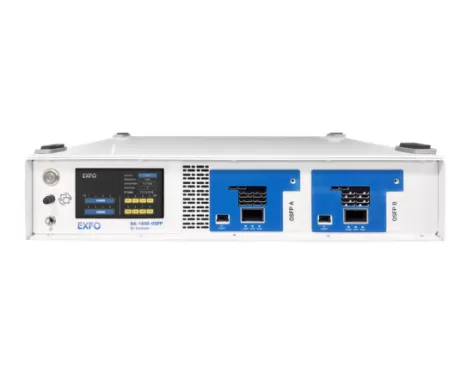
Designed for fast and precise 1.6T interconnect validation, the BA-1600-OSFP helps data centers and hyperscalers accelerate cable and transceiver testing for next-generation AI infrastructure.
Two independent 1.6T OSFP ports supporting up to 3.2T total test capacity
Test two transceivers simultaneously or validate a complete end-to-end high-speed interconnect
Support the full testing lifecycle for 1.6T, 800G, and 400G applications across lab, manufacturing, and live environments
Maintain high signal integrity with native OSFP interfaces, clear eye diagrams, and a low error floor
Perform real-time FEC, BLER, PAM4, and BER analysis for comprehensive high-speed validation
Simplify testing workflows with an intuitive GUI, automation capabilities, and API support
Verifying ultra-low error rates can be time-consuming with conventional BER testing, often requiring hours or even days. The BA-1600-OSFP combines BLER monitoring with comprehensive FEC validation to streamline receiver testing and provide greater confidence across 1.6T, 800G, and 400G transceivers.
Speed up ultra-low BER verification
Increase confidence in receiver performance
Combine BLER monitoring with comprehensive FEC validation
Validate 1.6T, 800G, and 400G transceivers

Dual 1.6T testing:Test two 1.6T transceivers simultaneously or validate a complete end-to-end high-speed interconnect through the dual OSFP ports.
End-to-end lifecycle validation:Support testing of 1.6T, 800G, and 400G applications across laboratory, manufacturing, and live environments.
High-performance hardware design:Native OSFP interfaces provide excellent signal integrity, clean eye diagrams, and a low error floor for reliable measurements.
Comprehensive FEC analysis:Generate and analyze FEC in real time, including pre- and post-FEC BER, symbol error distribution, and FEC margin measurements.
Efficient BLER measurement:Analyze block error ratio statistics and estimate FLR efficiently, helping reduce the measurement time required for ultra-low BER testing.
Advanced PAM4 testing:Evaluate PAM4-based high-speed signals and verify signaling performance for next-generation interconnects.
 Whatsapp Us