

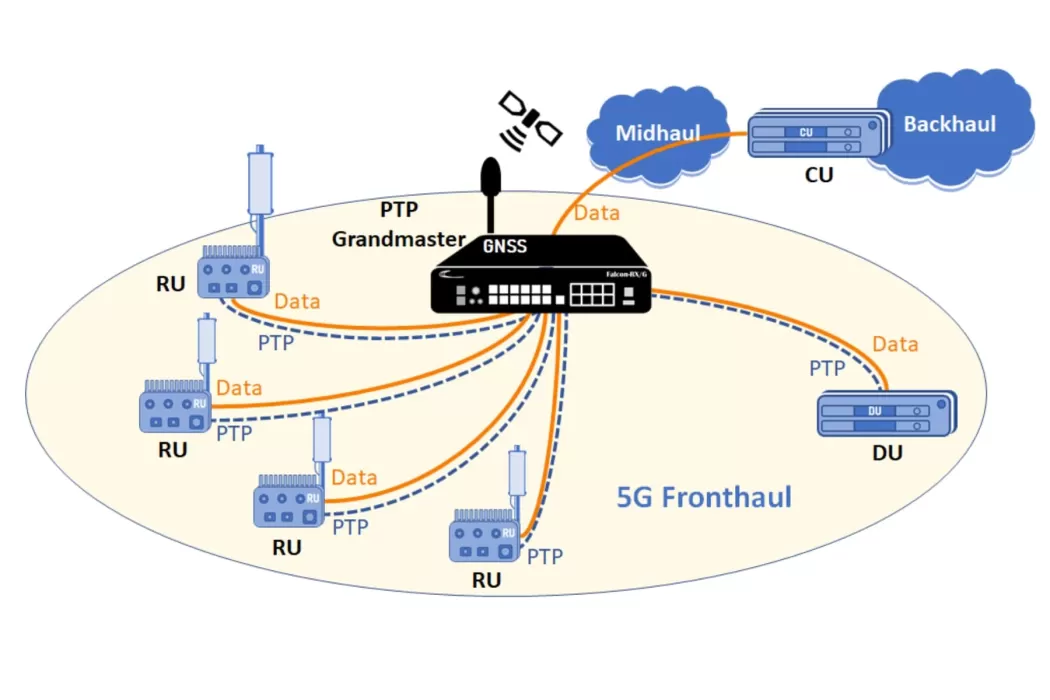
Have you ever wondered how telecom networks manage millions of calls, video streams, and mobile connections without creating chaos in the background?
The real answer often comes down to timing. And today, timing is no longer just about clocks on a wall. It is about ultra precise synchronization across entire telecom systems.
As telecom networks move toward 5G, cloud infrastructure, edge computing, and real time services, network timing has become far more important than many people realize.
The thing is, telecom systems depend on every network element working together at the exact right moment. Even tiny timing errors can create dropped calls, poor data transfer, packet loss, and unstable network performance. Thats where PTP Grandmaster Clock Synchronization enters the picture.
PTP or Precision Time Protocol helps telecom networks distribute highly accurate time across devices. The PTP Grandmaster Clock acts as the main timing source that keeps the entire network synchronized.
How PTP Grandmaster Clock Synchronization Supports Modern Telecom Networks?
PTP Grandmaster Clock Synchronization Keeps Network Timing Accurate
The biggest reason telecom networks depend on PTP Grandmaster Clock Synchronization is timing accuracy.
A telecom network contains thousands of devices like routers, switches, base stations, and servers. Every device must follow the same timing reference. The PTP Grandmaster Clock becomes the central source of accurate time for all connected systems.
Without synchronization, devices start drifting apart in microseconds or milliseconds. That may sound small, but in telecom systems, even tiny timing mismatches can create major communication issues.
Telecom Networks Need Synchronization for 4G and 5G Performance
Modern 4G LTE and 5G networks heavily depend on precise timing.
5G networks especially require extremely low latency and high-speed communication. Features like massive MIMO, beamforming, and network slicing only work properly when all network elements stay synchronized.
PTP Grandmaster Clock Synchronization helps telecom operators maintain the timing precision required for these advanced technologies.
That is why PTP has become a standard choice in modern telecom infrastructure.
PTP Grandmaster Clocks Reduce Signal Interference
Telecom networks operate across shared radio frequencies. If network elements transmit signals at the wrong time, interference increases quickly.
PTP Grandmaster Clock Synchronization helps coordinate transmission timing between cellular towers and network devices. This reduces overlapping signals and improves spectrum efficiency.
In practical terms, users experience fewer dropped calls and better mobile internet performance.
Accurate Synchronization Improves Call Quality and Data Stability
Nobody likes poor call quality or unstable internet connections.
One hidden reason behind smooth telecom performance is synchronized network timing. PTP Grandmaster Clocks help maintain stable communication sessions between devices and network systems.
When timing stays accurate, voice packets and data packets arrive in the correct sequence. This improves call clarity, reduces jitter, and stabilizes video streaming performance.
For applications like VoIP, video conferencing, online gaming, and remote collaboration, synchronization plays a direct role in user experience.
PTP Synchronization Supports Network Handover Between Towers
When you move during a phone call or while using mobile internet, your connection transfers between nearby towers. This process is called handover.
For handovers to happen smoothly, telecom towers must stay synchronized. PTP Grandmaster Clock Synchronization helps neighboring towers coordinate timing during these transitions.
Without accurate synchronization, users may experience dropped calls or interrupted data sessions while moving.
Telecom Operators Need Better Network Reliability
Network downtime costs telecom company money and damages customer trust.
PTP Grandmaster Clock Synchronization improves network stability by providing consistent timing across infrastructure. Reliable synchronization helps operators detect faults faster and maintain predictable network behavior.
PTP allows operators to maintain synchronization even across large geographic areas.
This creates more stable and reliable telecom services for users.
PTP Grandmaster Clocks Help Support Financial and Enterprise Services
Telecom infrastructure does more than mobile communication today.
Banks, stock exchanges, cloud providers, industrial systems, and enterprise networks also rely on telecom synchronization services. Many industries require precise timestamp accuracy for compliance and operational reasons.
PTP Grandmaster Clock Synchronization helps telecom operators provide accurate timing distribution to these sectors.
GPS Alone Cannot Solve All Synchronization Challenges
Many people assume GPS handles all network timing automatically. But telecom operators face several GPS related challenges.
GPS signals can become weak indoors or in dense urban environments. Weather conditions, signal blocking, and security risks like GPS spoofing can also affect reliability.
PTP Grandmaster Clock Synchronization provides an additional layer of timing distribution inside the network itself.
Industry Standards and Compliance Depend on Accurate Timing
Telecom operators must follow strict industry standards for synchronization performance.
PTP Grandmaster Clock Synchronization helps operators meet these standards while maintaining service quality.
Compliance is not just about regulations. It also ensures interoperability between equipment from different vendors and network technologies.
Summarize
PTP Grandmaster Clock Synchronization has become one of the most important technologies inside modern telecom networks. While most users never notice it directly, accurate synchronization affects call quality, internet stability, mobile performance, and overall network reliability every single day. The important thing to understand is simple. Faster networks are not only about speed. They are also about timing.
FAQS
What are the benefits of using PTP Grandmaster Clocks in telecom networks?
PTP Grandmaster Clocks improve timing accuracy, reduce network errors, support smooth communication, and maintain reliable telecom service performance.
Which industries commonly use PTP Grandmaster Clock synchronization systems?
Telecom, broadcasting, financial services, data centers, and smart infrastructure sectors depend on precise network timing synchronization systems.
What should I look for before buying a PTP Grandmaster Clock?
Check timing accuracy, network compatibility, reliability, security features, scalability, and long-term support before selecting synchronization equipment.
Is PTP Grandmaster Clock synchronization good for 5G telecom networks?
PTP Grandmaster synchronization supports stable 5G performance, accurate timing coordination, and reliable communication across telecom infrastructure systems.
Which type of telecom network benefits most from PTP synchronization?
5G, LTE, fiber optic, and large enterprise telecom networks receive better timing accuracy through advanced PTP synchronization systems.
 Whatsapp Us