

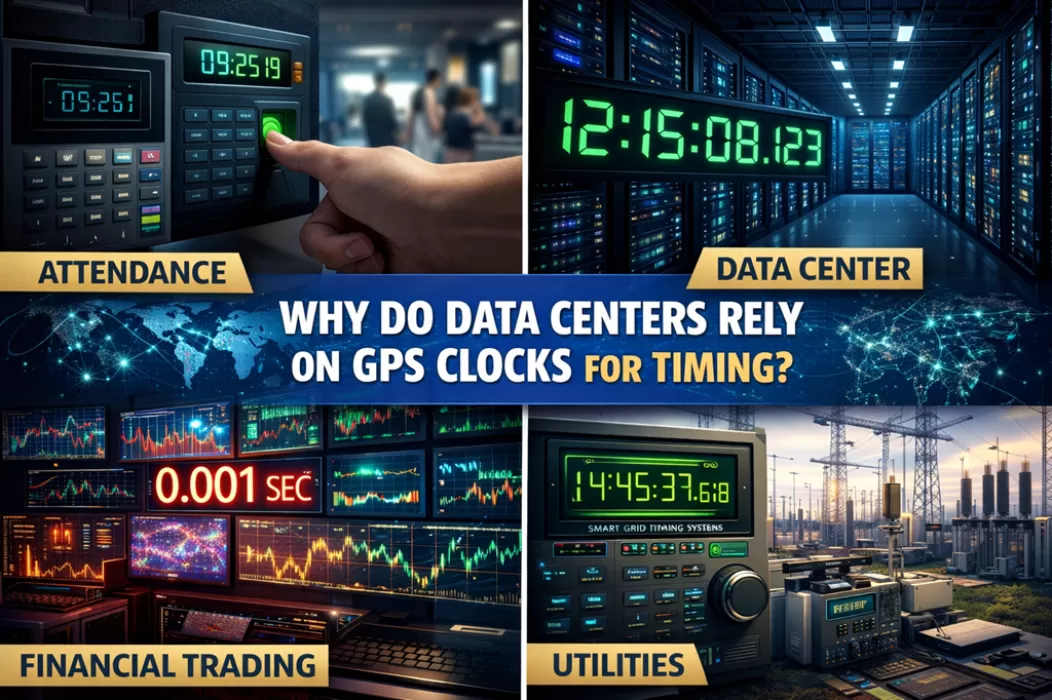
Have you ever wondered how massive data centers keep thousands of servers perfectly in sync every second? As digital systems grow faster and more connected, even a tiny timing error can cause serious issues.
People often ask what GPS clocks are, how they work inside data centers, and why accurate timing matters so much.
A GPS clock is a timing device that receives signals from Global Positioning System satellites to provide extremely precise time. Data centers use this time to synchronize servers, networks, and applications. The system works by locking internal clocks to atomic time signals sent from satellites.
Key Takeaways
• GPS clocks synchronize servers and networks with a shared time reference
• Accurate timing improves reliability security and performance
• Consistent timestamps help troubleshooting and monitoring
• Distributed systems depend on universal time coordination
• GPS timing supports compliance and high precision operations
Why accurate timing in data centers affects your digital experience?
You may not see data centers, but you depend on them every day. Every message you send, video you stream, or payment you make passes through systems that need perfect timing. When servers stay synchronized, your apps run smoothly and your data stays consistent.
Accurate timing also improves reliability and security. When systems agree on the exact time, they can detect errors, trace events, and protect transactions. For you, this means fewer service interruptions and safer digital services.
Top reasons data centers rely on GPS clocks for precise timing
GPS clocks keep all servers synchronized
Data centers run thousands of servers that must act like a single system. GPS clocks provide a shared time source so every server follows the same reference.
When servers stay synchronized, tasks happen in the correct order. For example, database updates and file transfers depend on accurate timestamps.
GPS timing supports accurate data logging
Every action inside a data center creates logs. These logs record when events happen and help teams troubleshoot problems.
With GPS clocks, timestamps remain consistent across all machines. Engineers can trace issues quickly because every log follows the same timeline.
GPS clocks improve network coordination
Modern data centers use complex networks that move huge amounts of data. Network devices must coordinate traffic with precise timing.
GPS clocks help switches and routers align their operations. This reduces delays and packet loss. As a result, users experience faster and more reliable connections.
GPS timing strengthens security monitoring
Security systems depend on accurate event tracking. When a suspicious activity occurs, teams need exact timestamps to understand what happened.
GPS clocks create a trusted time reference for security tools. This helps analysts correlate events across systems.
GPS clocks support distributed systems
Many services run across multiple data centers in different locations. These distributed systems must share a common sense of time.
GPS clocks provide a universal reference that works anywhere on Earth. This allows separate facilities to coordinate actions and maintain consistent data.
GPS timing enables high frequency transactions
Financial platforms and trading systems rely on data centers. These systems require extremely precise timing to process transactions fairly.
GPS clocks deliver time accuracy measured in nanoseconds. This ensures transactions occur in the correct sequence and meet regulatory standards.
GPS clocks reduce dependency on local time sources
Local clocks can drift over time due to temperature and hardware limits. Even small drift can cause serious synchronization errors.
GPS clocks continuously correct internal timing using satellite signals. This keeps systems accurate without constant manual adjustment.
GPS timing supports automation and orchestration
Data centers use automated tools to manage workloads and resources. These tools schedule tasks based on time.
Accurate GPS timing ensures scheduled actions occur exactly when expected. This improves efficiency and prevents task conflicts.
GPS clocks help with compliance and standards
Many industries require strict timing accuracy for audits and reporting. Regulations often demand traceable and verified timestamps.
GPS clocks provide time that links to international standards. This helps organizations meet compliance requirements with confidence.
GPS timing increases overall system reliability
Reliable timing forms the foundation of stable operations. When all components share the same clock, systems behave predictably.
GPS clocks reduce errors caused by timing mismatches. This leads to smoother performance and fewer unexpected failures.
FAQS
Why do data centers need accurate timing?
Data centers need accurate timing to keep servers synced prevent errors and ensure smooth communication between systems.
What is a GPS clock in a data center?
A GPS clock is a device that receives satellite signals to provide exact time to all connected equipment.
How do GPS clocks improve network performance?
GPS clocks improve network performance by keeping all devices aligned which reduces delays and prevents data conflicts.
Why is synchronized timing important for data security?
Synchronized timing helps track events accurately which supports security monitoring and makes problem detection faster and easier.
How do GPS clocks support backup and recovery systems?
GPS clocks ensure backup systems record exact timestamps which helps teams restore data correctly after failures.
Why are GPS clocks more reliable than internet time sources?
GPS clocks use direct satellite signals so they stay accurate even when internet connections become slow or unstable.
How do GPS clocks help large data centers scale operations?
GPS clocks provide a single trusted time source that keeps expanding systems coordinated as the data center grows.
What problems occur without precise timing in data centers?
Without precise timing servers can lose sync cause errors and create confusion in logs and transactions.
 Whatsapp Us