

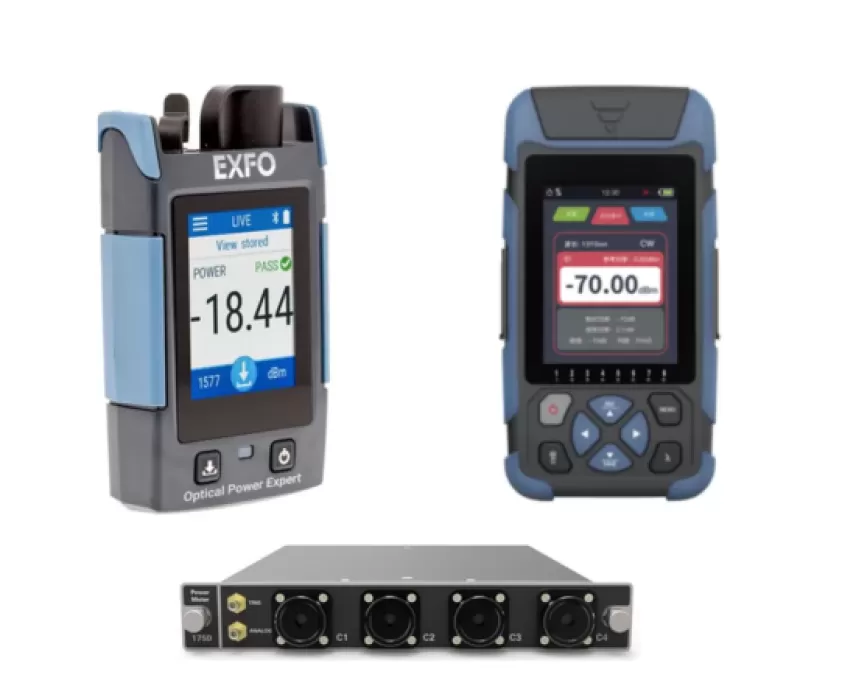
An Optical Power Meter measures the power level of an optical signal traveling through a fiber optic link. It is widely used during fiber installation, commissioning, maintenance, troubleshooting and network testing.
For telecom networks, FTTH and PON deployments, data centers, enterprise networks and laboratory environments, an Optical Power Meter helps technicians verify whether optical signal levels are within the required operating range.
In this guide, we explain what an Optical Power Meter is, how it works, what it measures, its applications and the key factors to consider when selecting one for fiber optic testing.
What Is an Optical Power Meter?
An Optical Power Meter is a fiber optic test instrument used to measure the optical power of a light signal received through an optical fiber.
The measurement is commonly displayed in dBm, which represents optical power on a logarithmic scale. Depending on the instrument and application, measurements may also be displayed in other units.
An Optical Power Meter can be used to:
- Measure received optical power
- Verify optical signal levels
- Measure fiber link loss when used with a suitable light source
- Check fiber optic connections
- Troubleshoot excessive optical loss
- Verify network performance during installation and maintenance
Different Optical Power Meter models support different wavelength ranges, power measurement ranges, connector types and testing features.
How Does an Optical Power Meter Work?
An Optical Power Meter works by detecting the optical signal entering the instrument through a fiber connection.
The meter uses a photodetector to convert the incoming optical signal into an electrical signal. The instrument then processes this signal and displays the measured optical power on its screen.
The basic testing process is:
- Connect the fiber under test to the Optical Power Meter.
- Select the appropriate wavelength.
- Allow the measurement to stabilize.
- Observe the optical power reading.
- Compare the result with the expected signal level or reference value.
For fiber loss testing, an Optical Power Meter can be used together with an Optical Light Source. The light source transmits a known optical signal through the fiber, while the power meter measures the received power. The difference between the reference and measured power can then be used to determine the link loss.
What Does an Optical Power Meter Measure?
An Optical Power Meter primarily measures the power of an optical signal at a specific wavelength.
Depending on the model, it can be used for:
Absolute Optical Power Measurement
Absolute power measurement determines the amount of optical power being received at the measurement point. This is useful for checking whether a fiber link is receiving an adequate signal.
Fiber Link Loss
When combined with an appropriate optical light source, an Optical Power Meter can help measure the insertion loss or attenuation of a fiber link.
Optical Signal Levels
Technicians can use an OPM to verify whether optical signals are within the acceptable operating range of network equipment.
Multiple Wavelength Measurements
Many professional Optical Power Meters support multiple wavelengths, allowing technicians to test different fiber optic network applications.
Applications of Optical Power Meters
Optical Power Meters are used across many fiber optic testing environments.
1. Fiber Optic Installation
During fiber installation and commissioning, technicians need to verify that optical signal levels are within the expected range. An Optical Power Meter provides a quick way to check the performance of a newly installed fiber link.
2. Telecom Network Testing
Telecommunication networks rely on fiber optic infrastructure for high-speed data transmission. Optical Power Meters can be used during installation, maintenance and troubleshooting of these networks.
3. FTTH and PON Testing
Fiber-to-the-Home (FTTH) and Passive Optical Network (PON) deployments require accurate optical signal measurement. Suitable Optical Power Meters can help technicians verify optical power levels during installation and maintenance.
4. Data Center Fiber Testing
Data centers use large numbers of fiber optic connections to support high-speed communication. Optical Power Measurement can help verify fiber links and identify abnormal signal levels.
5. Fiber Network Troubleshooting
A sudden reduction in optical power can indicate problems such as poor connectors, excessive fiber bending, damaged fiber or other sources of optical loss. An Optical Power Meter can help technicians investigate these issues.
6. Laboratory and R&D Testing
Optical Power Meters are also used in laboratories and research environments where accurate optical power measurements are required during the development and testing of fiber optic systems.
Optical Power Meter vs OTDR: What Is the Difference?
An Optical Power Meter and an Optical Time-Domain Reflectometer (OTDR) are both important fiber optic testing instruments, but they perform different functions.
An Optical Power Meter measures the optical power at a particular point in the fiber link. It is useful when technicians need to quickly verify signal levels or measure link loss with an optical light source.
An OTDR sends optical pulses into the fiber and analyzes the returned light to characterize the fiber link. It can help identify events such as connectors, splices, bends, excessive loss and fiber breaks.
In many professional fiber testing environments, both instruments are used together because they provide different types of information.
How to Choose the Right Optical Power Meter
Selecting the right Optical Power Meter depends on the type of fiber network and testing requirements.
Wavelength Range
Check whether the meter supports the wavelengths used in your application. Common fiber optic wavelengths include 850 nm, 1310 nm, 1490 nm, 1550 nm and 1625 nm.
Measurement Range
The measurement range should be suitable for the expected optical power levels in your network.
Accuracy
Higher measurement accuracy is important when precise optical power and loss measurements are required.
Resolution
Resolution determines how precisely the instrument can display changes in optical power.
Connector Compatibility
Make sure the Optical Power Meter supports the connectors used in your fiber network or has suitable interchangeable adapters.
Portability
For field technicians, a compact and battery-powered Optical Power Meter can make installation and maintenance work easier.
Data Storage and Connectivity
Some advanced instruments provide features such as internal memory, USB connectivity, Bluetooth or test-result reporting, which can be useful when test results need to be documented.
Why Is Optical Power Measurement Important?
Accurate optical power measurement helps maintain the performance and reliability of fiber optic networks.
If optical power is too low, the receiving equipment may not receive a reliable signal. Excessive optical power can also be an issue for certain optical components and systems.
Regular optical power testing can help technicians:
- Verify fiber link performance
- Detect abnormal signal levels
- Identify excessive optical loss
- Validate newly installed fiber links
- Troubleshoot network problems
- Support preventive maintenance
For this reason, Optical Power Meters are an important part of a professional fiber optic testing toolkit.
Optical Power Meter Solutions from Khushi Communications
Khushi Communications offers a range of Optical Power Meter solutions for different fiber optic testing requirements.
The available solutions can support applications including fiber installation, telecom network testing, FTTH and PON testing, data center testing, maintenance and troubleshooting.
The product range includes solutions such as the KI2600 Series, Optical Power Expert, FiberBasix 50, FTBx-1750, KI9600A Series and K300 Series, depending on the required application and measurement specifications.
When selecting an Optical Power Meter, it is important to consider the required wavelength range, optical power range, accuracy, connector type and intended testing environment.
For the available product range, explore the Optical Power Meter category from Khushi Communications.
Frequently Asked Questions
What is an Optical Power Meter used for?
An Optical Power Meter is used to measure optical signal power in fiber optic networks. It is commonly used for installation, commissioning, maintenance, troubleshooting and fiber link loss testing.
Can an Optical Power Meter measure fiber loss?
Yes. An Optical Power Meter can be used with a suitable Optical Light Source to measure the loss or attenuation of a fiber optic link.
What is the difference between an Optical Power Meter and an OTDR?
An Optical Power Meter measures optical power at a specific point, while an OTDR analyzes the fiber link using optical pulses to identify events such as splices, connectors, bends and breaks.
Which wavelengths are commonly measured by an Optical Power Meter?
Common fiber optic wavelengths include 850 nm, 1310 nm, 1490 nm, 1550 nm and 1625 nm. The supported wavelengths depend on the specific instrument.
Is an Optical Power Meter useful for FTTH testing?
Yes. Suitable Optical Power Meters are commonly used to verify optical signal levels during FTTH and PON installation, commissioning and maintenance.
How do I choose an Optical Power Meter?
Consider the wavelength range, measurement range, accuracy, resolution, connector compatibility, portability and additional features required for your application.
Conclusion
An Optical Power Meter is a fundamental instrument for measuring and verifying optical signal levels in fiber optic networks. From telecom and FTTH deployments to data centers, enterprise networks and laboratory testing, accurate optical power measurement helps technicians maintain reliable fiber connectivity.
Choosing the right instrument requires consideration of factors such as wavelength range, measurement range, accuracy, connector compatibility and the intended testing environment.
If you are looking for an Optical Power Meter for fiber optic testing, explore the range available from Khushi Communications and select a solution according to your network and measurement requirements.
 Whatsapp Us