

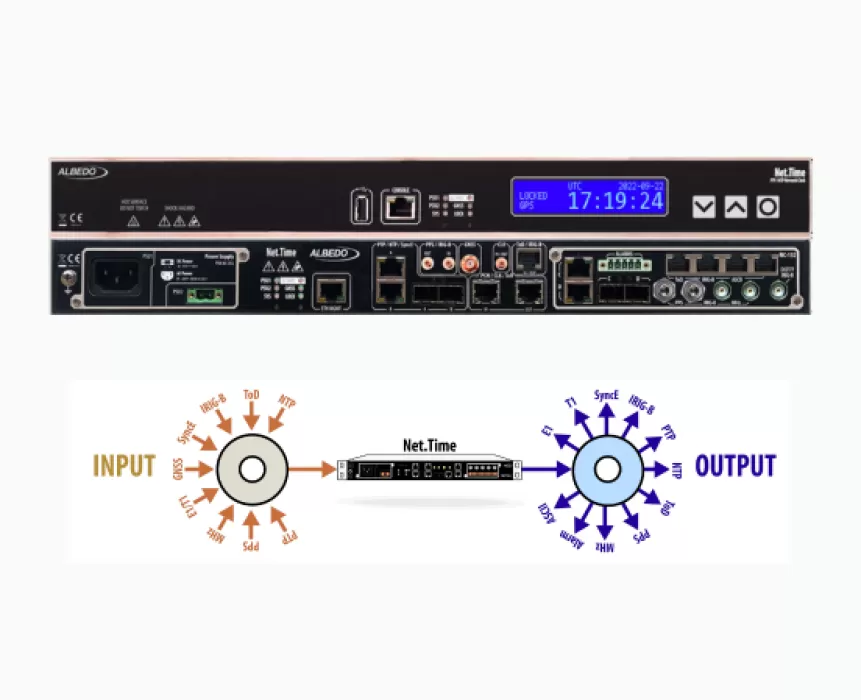
If you've ever seen a timestamp mismatch in your server logs, a “clock skew” error during a login, or a compliance auditor ask “how is your network time synchronized?” — you've already run into the exact problem a GPS NTP timing server exists to solve.
This guide breaks down what it is, how it works, and why so many telecom networks, data centers, and banks across India now treat accurate time as critical infrastructure, not an afterthought.
What Does “NTP” Actually Mean?
NTP stands for Network Time Protocol. It's the standard method computers and network devices use to keep their internal clocks synchronized with each other over a network.
Every device's internal clock drifts — some faster, some slower. A server might lose a few seconds a day; a router might gain a few. On their own, that seems trivial. Across a network of hundreds or thousands of devices, it creates a real problem: logs that don't line up, transactions that appear to happen “out of order,” and security systems that can't reliably tell what happened when.
NTP fixes this by giving every device on the network a single, shared source of truth for time.
What is a GPS NTP Timing Server?
A GPS NTP timing server is a dedicated hardware appliance that pulls extremely accurate time from GPS satellites and then distributes that time across your network using the NTP protocol.
Instead of relying on a public internet time source (which can be slow, insecure, or unreliable), a GPS NTP server has its own antenna that receives timing signals directly from GPS satellites — the same satellites that power global positioning worldwide, which also happen to carry atomic-clock-level time accuracy. The server then converts that satellite signal into a time reference and pushes it out to every connected device: servers, switches, routers, security systems, billing platforms, and more.
In short: GPS gives the server the time. NTP is how the server shares it with everything else.
How Does It Actually Work? (In Plain Terms)
-
Reception — A GPS antenna, usually mounted on a rooftop with a clear sky view, picks up timing signals from GPS satellites.
-
Processing — The NTP server converts the satellite signal into a precise time reference, often accurate to within nanoseconds or microseconds.
-
Distribution — The server then acts as a “stratum 1” time source, sending accurate time to all connected devices on the network using the NTP protocol.
-
Synchronization — Every device that queries the server — from a core telecom switch to a bank's transaction server — adjusts its own clock to match, keeping the entire network in sync.
This is why you'll often see GPS NTP servers described as sitting at “stratum 1” in the timing hierarchy — they're one step removed from the original atomic-clock-grade time source (GPS), making them one of the most accurate and trustworthy time references a network can use.
Why Not Just Use a Free Internet NTP Pool?
This is the question most people ask once they understand the basics — and it's a fair one, since free public NTP pools do exist.
The short answer: public NTP pools are fine for a home network, but they fall short for anything mission-critical, because:
-
Accuracy is inconsistent — internet-based time sources depend on network latency, which varies constantly.
-
No control or ownership — you're relying on a third party's server, with no guarantee of uptime or accuracy.
-
Security risk — public time sources can be spoofed or manipulated, and many compliance frameworks specifically require synchronization to a trusted time source, not a public one.
-
No redundancy — if the public server goes down or gets overloaded, your network's timing goes with it.
A dedicated GPS NTP server removes all of that uncertainty — you own the time source, it's independent of internet reliability, and it's accurate enough for the most demanding use cases.
Who Actually Needs One?
While any organization benefits from accurate time, a GPS NTP timing server becomes essential — not optional — in a few specific environments:
-
Telecom & 5G networks, where synchronization directly affects call handoff, signal quality, and network performance.
-
Data centers, where transaction logs, backups, and security events all depend on precise, trustworthy timestamps.
-
Banking, NBFCs & fintech, where regulatory frameworks increasingly require systems to be synchronized to a trusted, traceable time source as part of cybersecurity and audit readiness.
-
Power & utility substations (IEC 61850), where protection and control systems need microsecond-level timing accuracy.
-
Railways and other critical infrastructure, where signaling and safety systems depend on precise, consistent timing across the network.
NTP vs. GPS NTP: What's the Difference?
It's worth clearing up one common confusion: “NTP” describes the protocol used to share time. It doesn't say anything about where that time comes from.
-
A software-only NTP setup might pull time from a public internet source — fine for low-stakes use, not ideal for anything critical.
-
A GPS NTP server pulls time from GPS satellites directly, giving you an independent, highly accurate, and secure time source — which is then shared using the same NTP protocol.
Some environments go a step further and use PTP (Precision Time Protocol) alongside or instead of NTP, for even tighter, sub-microsecond accuracy — common in telecom and power substation applications. We'll cover that comparison in detail in a follow-up post.
Key Takeaway
A GPS NTP timing server isn't just “another network box.” It's the component that ensures every device on your network agrees on what time it is — which turns out to matter enormously for security, compliance, and operational reliability once your network grows past a handful of devices.
If you're evaluating GPS NTP servers for your organization — whether for telecom infrastructure, a data center, or regulatory compliance — it helps to understand not just what the technology is, but which features actually matter for your use case: accuracy, redundancy, oscillator type, and supported profiles.
Explore our range of GPS NTP & PTP Timing Servers →
Frequently Asked Questions
What does NTP stand for?
NTP stands for Network Time Protocol — the standard used to synchronize clocks across computer networks.
What is the difference between NTP and GPS NTP server?
NTP is the protocol used to distribute time. A GPS NTP server is a hardware device that gets its time from GPS satellites and distributes it using the NTP protocol — offering much higher accuracy and independence from the internet.
Why is network time synchronization important?
Accurate time synchronization ensures logs, transactions, and security events across a network can be correctly ordered and correlated — which is critical for troubleshooting, security investigations, and regulatory compliance.
Is a GPS NTP server the same as a PTP server?
Not exactly. NTP is generally accurate to milliseconds, while PTP (Precision Time Protocol) can achieve nanosecond-level accuracy. Many modern timing servers, including GPS-based ones, support both protocols.
 Whatsapp Us