

_1920_x_700.webp)
Modern data centers are handling more traffic than ever. The growth of AI, machine learning, cloud applications, real-time analytics and other high-bandwidth workloads is driving the need for faster connectivity, higher bandwidth and lower latency.
At the heart of these high-speed connections are optical transceivers. These compact components connect switches, servers, routers and other network equipment, enabling high-speed data transmission across the data center and beyond.
But when a network experiences packet loss, poor performance or connectivity issues, how do you know whether the transceiver is actually faulty?
Replacing it immediately may seem like the easiest solution—but it is not always the right one.
Why Optical Transceivers Matter in Modern Data Centers
Optical transceivers play a critical role in today's data center infrastructure. As network speeds move from 100G and 400G toward 800G and beyond, the performance and reliability of these pluggable optics become increasingly important.
A reliable transceiver helps support:
-
High-speed data transmission
-
Low-latency network communication
-
Higher bandwidth requirements
-
Reliable connectivity between network devices
-
Efficient data center operations
-
Scalable network infrastructure
There is also another important consideration: power consumption.
Large data centers can contain thousands—or even tens of thousands—of optical transceivers. Every component contributes to the overall power requirement of the infrastructure. Efficient testing and better transceiver management can therefore support both operational efficiency and sustainability goals.
A Faulty Transceiver Isn't Always the Real Problem
When a network link is not performing as expected, the transceiver is often one of the first components to be replaced.
But what if the transceiver isn't actually defective?
A dirty connector, cable issue, configuration problem or another physical-layer issue can produce symptoms that look like a faulty optical module.
Without proper validation, technicians may replace perfectly functional transceivers simply because they cannot quickly determine whether the module is healthy.
This creates two problems:
Higher operational costs:
Good transceivers may be unnecessarily removed from inventory and replaced with new ones.
Unnecessary electronic waste:
Working components can end up being discarded because their actual condition was never properly verified.
This is where automated optical transceiver testing can make a significant difference.
The Challenge: Testing Transceivers Quickly and Accurately
Traditional transceiver troubleshooting can involve several manual steps. Technicians may need to check connectors, cables, optical power, link performance and other parameters before determining whether a transceiver should be replaced.
In a large data center, repeating this process across hundreds or thousands of modules can consume significant time.
Network teams therefore need a testing approach that is:
-
Fast
-
Repeatable
-
Automated
-
Reliable
-
Easy to use in field and data center environments
EXFO iOptics: Automated Optical Transceiver Validation
As a supplier of EXFO test and measurement solutions, Khushi Communications provides access to EXFO iOptics, an automated application designed to help technicians quickly assess the health of optical transceivers.
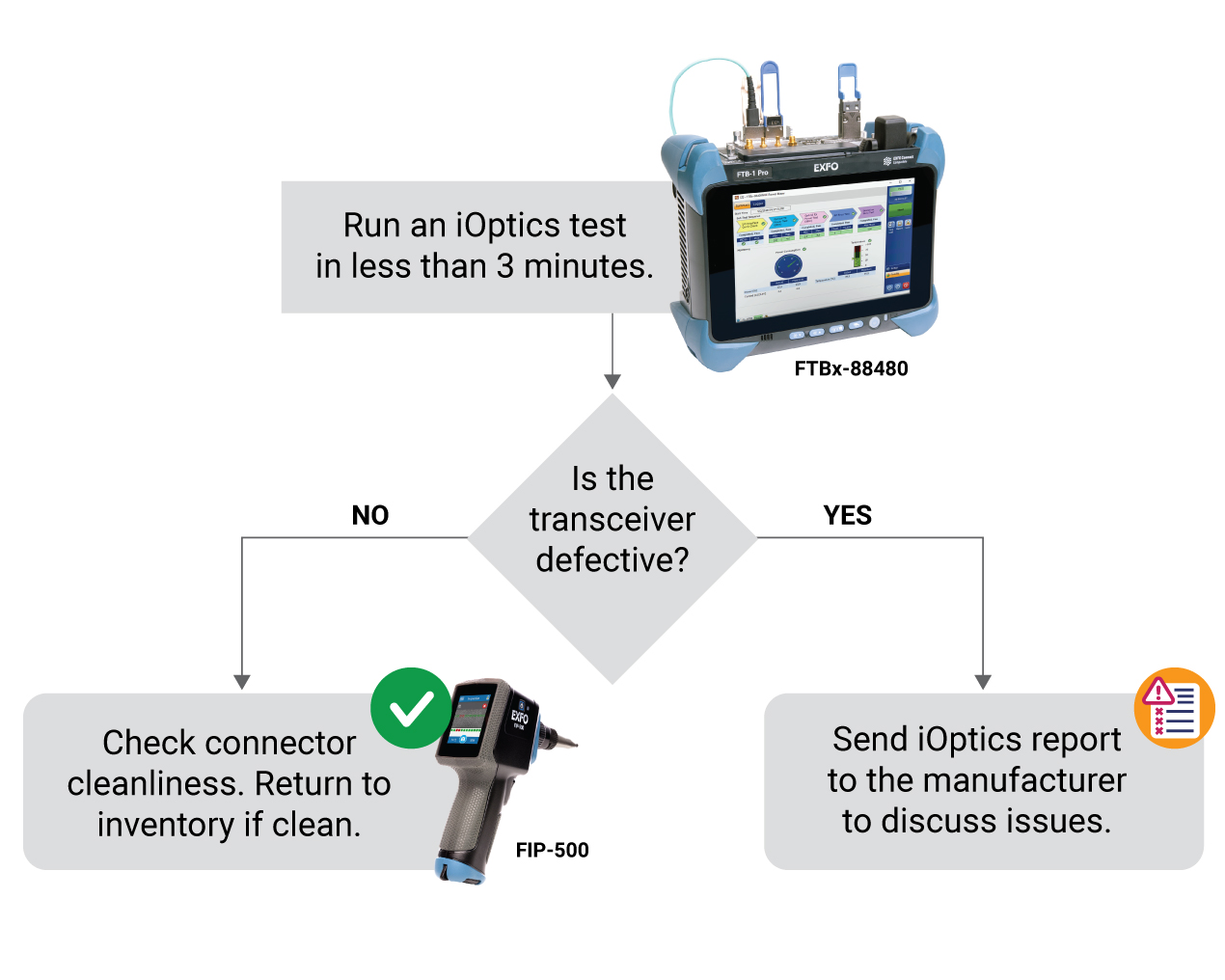
One of its key advantages is speed: iOptics can assess the health of a transceiver in less than three minutes.
Instead of immediately replacing a suspected module, technicians can first validate its condition and make a more informed decision.
If a transceiver is identified as defective, the generated test information can help support discussions with the transceiver manufacturer or supplier.
If the transceiver passes the validation process, connector cleanliness can be checked and the module can potentially be returned to inventory rather than unnecessarily discarded.
Supporting Multiple Transceiver and Cable Types
Modern data centers rarely rely on a single transceiver form factor.
EXFO iOptics supports a broad range of pluggable optics and connectivity technologies, including:
-
OSFP
-
QSFP28
-
QSFP56
-
QSFP+
-
SFP28
-
SFP+
-
SFP
-
AOC
-
DAC
This broad support makes automated validation useful for data centers managing a mixed inventory of optical modules and high-speed interconnects.
Beyond Direct-Detect Optics: Testing Coherent Transceivers
Optical networks are also increasingly adopting coherent pluggable technologies for data center interconnects, metro networks and core transport applications.
For these environments, EXFO offers solutions designed to validate coherent optical technologies.
DCO iOptics
DCO iOptics helps validate the health and operation of coherent transceivers such as 400ZR and OpenZR+.
DCO BERT
DCO BERT is designed to validate coherent point-to-point links, including technologies such as 100ZR, 400ZR and OpenZR+, helping network teams verify the performance of the physical infrastructure.
Together, these solutions extend optical validation beyond conventional direct-detect transceivers and into emerging coherent optical applications.
Why Automated Transceiver Validation Makes Business Sense
For data center operators, optical testing is not simply about finding defective hardware. It is also about improving the overall efficiency of network operations.
A structured validation process can help organizations:
Reduce unnecessary replacements
Test before replacing a suspected transceiver.
Minimize troubleshooting time
Automated testing can provide faster insight into the condition of an optical module.
Improve inventory management
Healthy transceivers can be identified and returned to service instead of being discarded.
Reduce operational costs
Avoiding unnecessary replacement of functional optics can lower hardware expenditure.
Support sustainability initiatives
Extending the useful life of working components can help reduce electronic waste.
Improve network reliability
A repeatable validation process gives engineers greater confidence when troubleshooting high-speed links.
Preparing for 400G and 800G Data Center Networks
As AI infrastructure and high-performance computing continue to increase network bandwidth requirements, high-speed optical technologies are becoming increasingly important.
Testing is therefore becoming just as important as deployment.
For organizations working with 400G and 800G optical infrastructure, having the right test equipment can help engineers validate components before putting them into service—and troubleshoot them efficiently when network problems occur.
EXFO's high-speed testing portfolio, including solutions such as the FTBx-88480 Series and FTBx-88800 Series, provides test capabilities for today's high-speed Ethernet and data center environments.
Build a More Efficient Optical Testing Workflow
A transceiver should not automatically be considered defective simply because a network link is experiencing problems.
Test first. Diagnose accurately. Replace only when necessary.
Automated optical transceiver validation provides network engineers with a faster and more structured approach to troubleshooting while helping organizations control costs, reduce unnecessary waste and maintain reliable high-speed connectivity.
Khushi Communications supports customers with EXFO's advanced test and measurement solutions for optical, Ethernet, data center and high-speed network applications.
Looking for an optical transceiver testing solution for your data center or network lab? Contact Khushi Communications to discuss your application and testing requirements.
 Whatsapp Us