

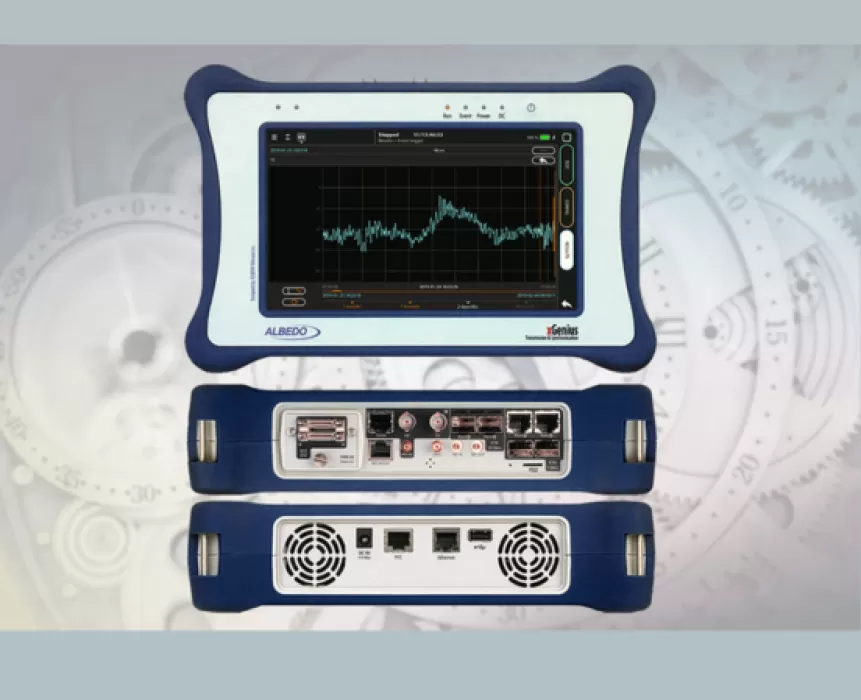
Precision timing has become the backbone of modern communication and critical infrastructure. From telecom networks and power utilities to financial trading systems and industrial automation, accurate synchronization is essential for maintaining reliable operations.
While many organizations verify that a device successfully locks to a PTP Grandmaster, this basic check is no longer sufficient. Today's complex networks require comprehensive validation to ensure every component performs accurately under real-world conditions.
This is where Advanced IEEE 1588 Test Modes provide significant value.
Why Basic PTP Testing Isn't Enough
The Precision Time Protocol (IEEE 1588) is designed to distribute highly accurate time across packet-based networks. However, network performance can be affected by several factors, including:
- Grandmaster clock failover
- Redundant synchronization paths
- Profile translation
- Network delay asymmetry
- Boundary and Transparent Clock performance
- Physical timing signal accuracy
To ensure reliable synchronization, engineers need to validate every stage of the timing network—not just confirm synchronization status.
Four Advanced IEEE 1588 Test Modes
Advanced PTP testing solutions such as ALBEDO xGenius and Zeus provide four specialized test modes that simplify validation while improving measurement accuracy.
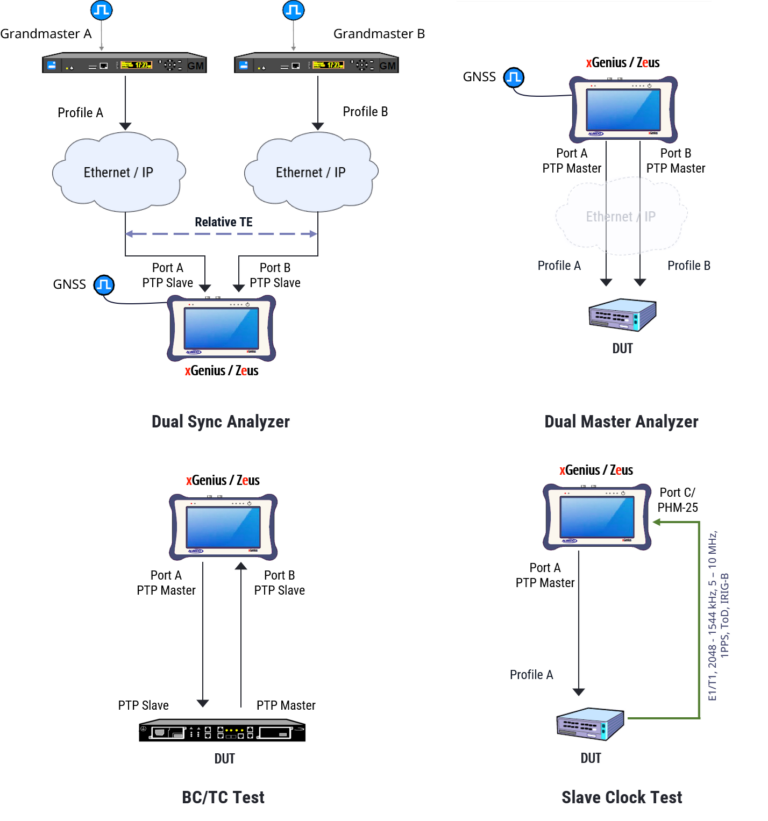
1. Dual Sync Analyzer
The Dual Sync Analyzer compares synchronization performance across two independent PTP sources. It helps engineers evaluate:
- Multiple Grandmasters
- Different PTP profiles
- Independent network segments
- Redundant synchronization paths
This enables quick identification of timing inconsistencies between separate synchronization sources.
2. Dual Master Analyzer
In redundant timing networks, selecting the correct Grandmaster is critical.
The Dual Master Analyzer validates:
- Best Master Clock Algorithm (BMCA)
- Grandmaster selection
- Failover performance
- Time offset between Grandmasters
- Domain isolation
This ensures network devices respond correctly during timing source changes and failover events.
3. Boundary Clock and Transparent Clock Testing
Boundary Clocks and Transparent Clocks play a vital role in maintaining synchronization accuracy across large networks.
This test mode evaluates:
- Boundary Clock performance
- Transparent Clock behavior
- Correction field accuracy
- Timing noise
- Time error performance
Comprehensive testing helps verify that intermediate network devices preserve synchronization quality throughout the network.
4. Slave Clock (SC) Testing
Accurate physical timing outputs are essential for many critical applications.
The Slave Clock Test validates outputs such as:
- 1PPS (One Pulse Per Second)
- Time-of-Day (ToD)
- Frequency signals
- IRIG-B timing signals
By verifying these outputs against required timing specifications, engineers can ensure dependable synchronization for connected equipment.
Improved Accuracy with Shared Oscillator Architecture
One of the key advantages of advanced PTP testing platforms like xGenius and Zeus is their shared oscillator architecture.
Unlike multiple independent test instruments, a shared oscillator minimizes correlated measurement errors between ports. This results in:
- Higher measurement consistency
- Improved timing accuracy
- Greater confidence in test results
- Simplified testing workflows
Benefits of Advanced IEEE 1588 Testing
Organizations that implement advanced IEEE 1588 validation gain several advantages:
- Comprehensive verification of PTP network performance
- Faster identification of synchronization issues
- Reliable Grandmaster failover validation
- Accurate testing of Boundary and Transparent Clocks
- Validation of physical timing outputs
- Reduced troubleshooting time
- Increased network reliability
Conclusion
As timing accuracy becomes increasingly critical across telecommunications, utilities, industrial automation, and financial networks, advanced IEEE 1588 testing is no longer optional—it's essential.
Comprehensive validation helps ensure every element of the synchronization chain performs as expected, even under complex real-world conditions. By leveraging advanced test modes, engineers can confidently deploy and maintain highly reliable PTP networks while minimizing operational risks and improving overall synchronization performance.
 Whatsapp Us